The AI freshness clock for company information
Track how company changes move through publication, crawling, retrieval, citation, and AI answers without promising an update time.
Track each AI update clock separately
A website change can go live immediately yet remain absent from AI answers. Publication, crawl discovery, indexing, retrieval, citation, and answer adoption happen separately. Track each event by platform and prompt rather than promising a universal correction timetable.
A company may update a pricing page on Monday and still see an old price quoted weeks later. The old fact could survive in a cached or indexed page, a partner profile, a PDF, a copied article, learned model patterns, or a current retrieval that selected the wrong source. Calling all of these “ChatGPT has not updated” prevents useful diagnosis.
Google explains that recrawling can take from a few days to a few weeks and that requesting a crawl does not guarantee immediate inclusion (Google Search Central). OpenAI documents distinct crawler user agents and controls for its products (OpenAI crawler documentation). These platform-specific boundaries do not amount to a cross-platform answer-adoption schedule.
Define the freshness layers
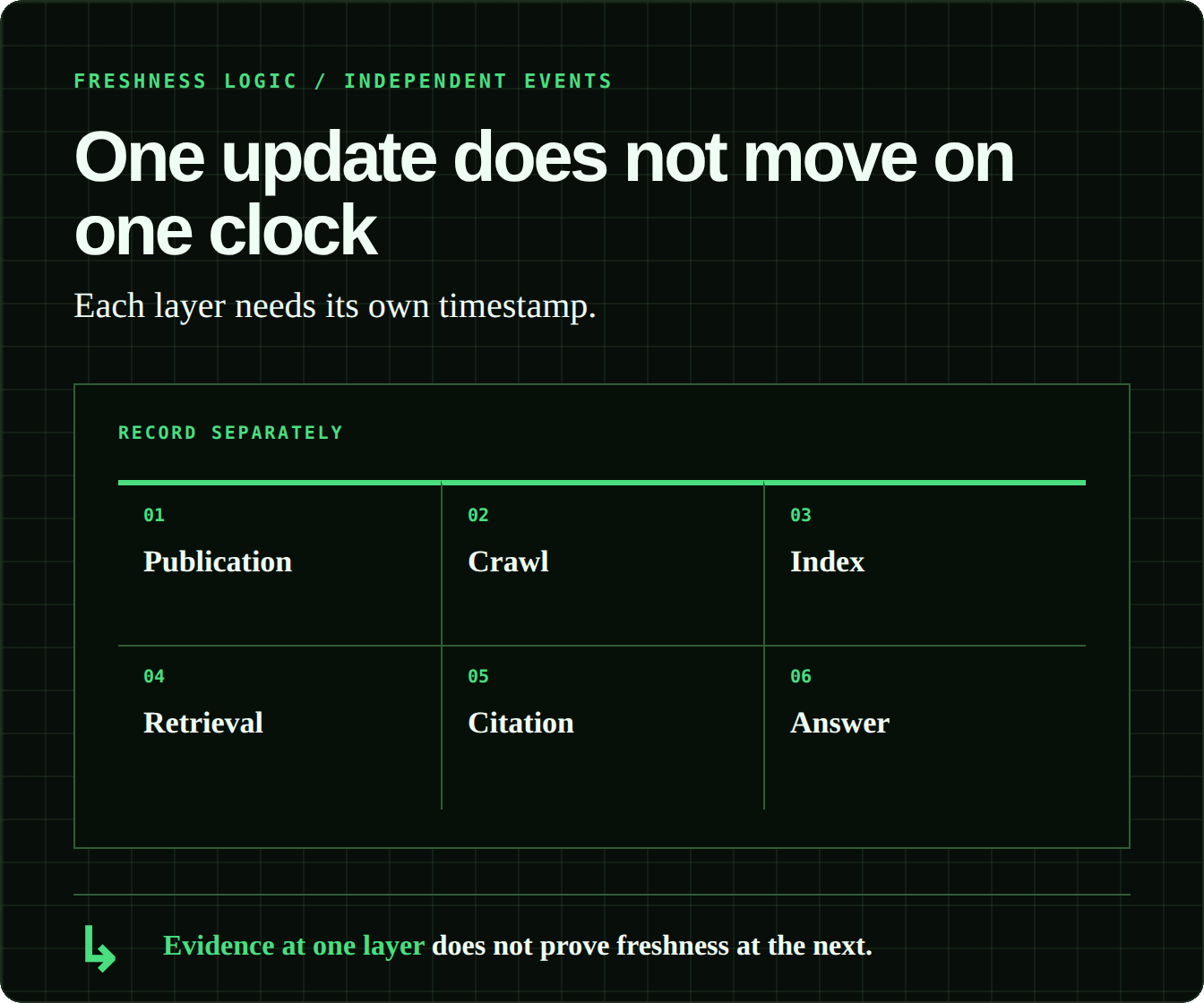
Use a separate timestamp for each observable event:
- Source publication: The current fact is live at a canonical URL.
- Crawl discovery: A platform crawler or search system can discover the changed page.
- Index freshness: A searchable index reflects the updated text, where observable.
- Retrieval freshness: The answer experience retrieves a current source for the prompt.
- Citation freshness: The displayed citation points to current evidence.
- Answer freshness: The generated statement adopts the current fact with proper scope.
A citation can be fresh while the answer is stale if the system misreads the page. An answer can be current without citing your page. Crawler logs can show a request but not prove indexing, retrieval, or use in an answer. Keep those claims separate.
Entity understanding is another layer. A current page about a namesake is not fresh evidence about your company. Run the entity collision test when brand, parent, product, or region is unclear.
Choose one timestamped company change
Use a material, verifiable change with a clear effective date, such as a product rename, acquired ownership, regional launch, retired feature, or pricing-structure change. Avoid testing vague positioning language.
Create a canonical claim:
Product X stopped accepting new customers on the Starter plan on 1 August 2026. Existing Starter contracts remain active until renewal.
The sentence includes subject, change, date, and exception. Record the prior wording and archive evidence under your normal legal and records policy. Then inventory every source that carries the old fact: product pages, docs, PDFs, release notes, schema, sitemaps, partner listings, marketplaces, press articles, and help-center copies.
The AI source-gap provenance map helps classify those sources. If many pages derive from one old announcement, the citation laundering audit shows how to group them rather than treating each copy as independent.
Build a cross-platform freshness timeline
For each platform and test prompt, record:
| Date | Layer | Evidence | Result |
|---|---|---|---|
| Aug 1 | Publication | Canonical page and release log | Current claim live |
| Aug 3 | Crawl | Verified server log entry | Approved bot fetched URL |
| Aug 5 | Search/index check | Current snippet or cached text | Updated text observed |
| Aug 6 | Retrieval | Full answer and visible URLs | Old partner page retrieved |
| Aug 6 | Citation | Cited passage inspected | Citation supports old plan |
| Aug 6 | Answer | Atomic claim review | Answer stale |
Use exact prompt wording and hold it stable. Include branded factual checks and realistic buyer prompts because retrieval may differ. Save product, visible mode, date, market, account state, response, citations, and repetition.
Do not keep rerunning until you get the desired answer and record only that run. Use a declared cadence. Daily checks may suit a high-risk correction for a short window. Weekly or monthly checks may suit ordinary product changes. Generated answers vary, so repeated runs help distinguish one fresh answer from stable adoption within the panel.
Diagnose where freshness breaks
If the canonical page is stale, fix publication first. If crawlers cannot access it under approved policy, check status, redirects, authentication, robots directives, CDN rules, canonical tags, and rendering. Access is necessary for some retrieval paths but does not guarantee use.
If search results still show old text, inspect duplicate URLs, canonicalization, internal links, sitemaps, and old pages. Follow platform guidance for recrawl requests, but do not promise a deadline.
If retrieval selects old third-party sources, compare their relevance and authority. Request corrections where the source is legitimate and materially wrong. Do not mass-publish duplicate pages to overpower it.
If a current citation accompanies a stale answer, inspect whether qualifications are buried or ambiguous. Put effective dates and exceptions close to the claim. If no visible source appears, label the source path unknown rather than guessing training data.
Handle contradictory old and new sources
Choose the canonical current source and state the supersession plainly: what changed, when, whom it affects, and where the old rule still applies. Redirect obsolete pages when readers no longer need them. If historical pages must remain, label them as archived and link to the current policy.
Update structured data only when it matches visible content. Reconcile PDFs, feeds, partner kits, marketplace records, and regional sites. Contact important external publishers with the current primary evidence and a precise requested correction.
For legal, safety, medical, or regulated misinformation, use the platform’s available reporting channels and involve appropriate counsel or compliance owners. A content audit is not a substitute for legal advice.
Report timelines without false promises
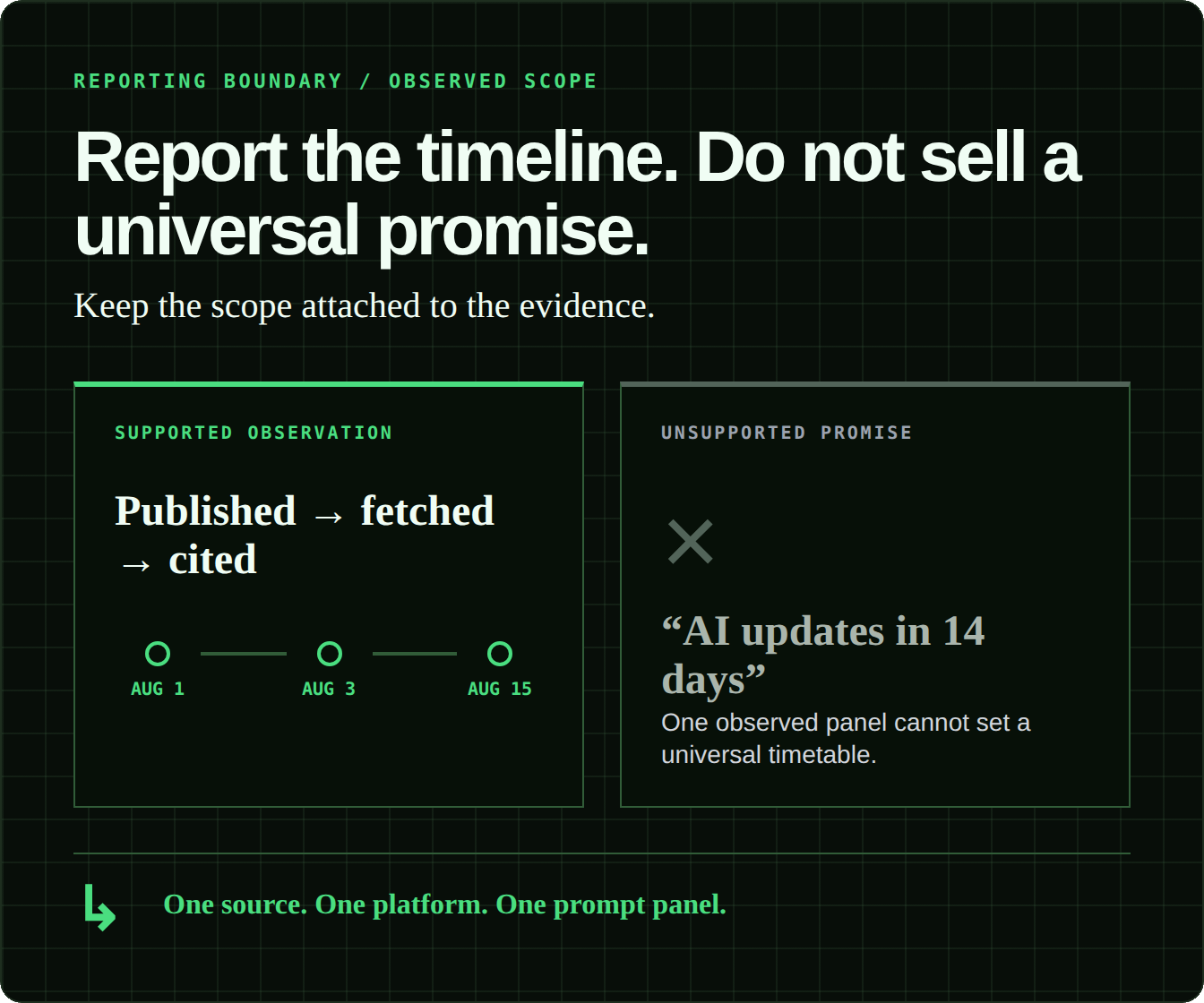
Report elapsed time for each observed layer: “The page was published on August 1, fetched on August 3, and first appeared in a cited answer in our weekly US prompt panel on August 15.” This describes one source, platform, prompt set, and period. Keep that scope attached instead of turning it into a general “AI updates in 14 days” claim.
Keep mention, citation, sentiment, recommendation, and business value separate. A corrected factual answer may still omit the brand. A current citation may carry a negative but accurate caveat. A recommendation may change without producing qualified traffic. Correlation after an update does not prove causation.
Leaf’s content audit for AI search helps reconcile stale owned pages. If you want a prioritized source and technical backlog, request a SEO and AEO audit. No responsible audit can guarantee when external systems will adopt a change.
Frequently asked questions
How do you correct outdated AI information?
Publish a clear current fact at its canonical source, reconcile conflicting owned pages, correct important external records, submit appropriate platform feedback, and retest a fixed prompt panel. Record publication, crawl, retrieval, citation, and answer evidence separately.
How do I fix wrong information that AI keeps repeating?
First classify the failure: stale source, entity collision, retrieval of an old page, contradiction, or unsupported generation. Correct the underlying evidence and retest. A pass requires the material claim to be current across repeated priority prompts, with uncertainty still reported.
Why can an old company page continue to influence AI answers?
It may remain accessible, indexed, linked, copied, or more relevant to a query than the new page. The answer may also reflect an unobserved path. Compare visible citations, search results, logs, and source conflicts without claiming access to private model internals.
How long does a website update take to appear in AI-generated answers?
Crawl discovery, indexing, retrieval, citation, and answer adoption operate on different schedules and vary by platform. Report the dates observed for your exact page and prompt panel instead of promising a fixed delay.
What is the difference between crawl, retrieval, citation, and answer freshness?
Crawl freshness concerns fetching the page. Retrieval freshness concerns selecting current evidence for a prompt. Citation freshness concerns the displayed source. Answer freshness concerns the generated claim itself. One can be current while another remains stale.
How should contradictory old and new sources be handled?
Name one canonical current source, add effective dates and exceptions, archive or redirect obsolete owned pages, and request precise corrections externally. Pass the source review when material owned contradictions are resolved. Continue monitoring external conflicts and label those you cannot control.
Keep the clock platform-specific
Add each observation to the same timeline without backfilling guessed dates. If a product changes its search mode or citation display, annotate the break in method. A clean record is more useful than a neat average assembled from incomparable systems.